Between brand strategy and a prescription sit seven minutes in a doctor’s office that nobody sees. NUMU Pharma scores every visit against your own visit model, tracks whether cycle messages actually landed, and writes the CRM entry from what was really said.
Field force is the single most expensive line in promotion and the least measurable one. What the company knows about the conversation in the doctor’s office is whatever the rep remembered by the evening.
More visits bring diminishing returns. A doctor’s calendar and a rep’s working day are both full — there is nowhere left to add activity.
Management never sees the actual content of the conversation in the moment — only what reaches CRM afterwards, and only what the rep chose to write down.
Double visits are rare, stressful and show untypical behaviour. A skill score is a manager’s impression, and every manager has their own criteria.
Top performers outperform baseline reps by 15–50%. Training is expensive and its outcome is never measured against real visits.
The 15–50% gap between the best and the average is not about people. It is about access to feedback — and closing it costs less than growing the team.
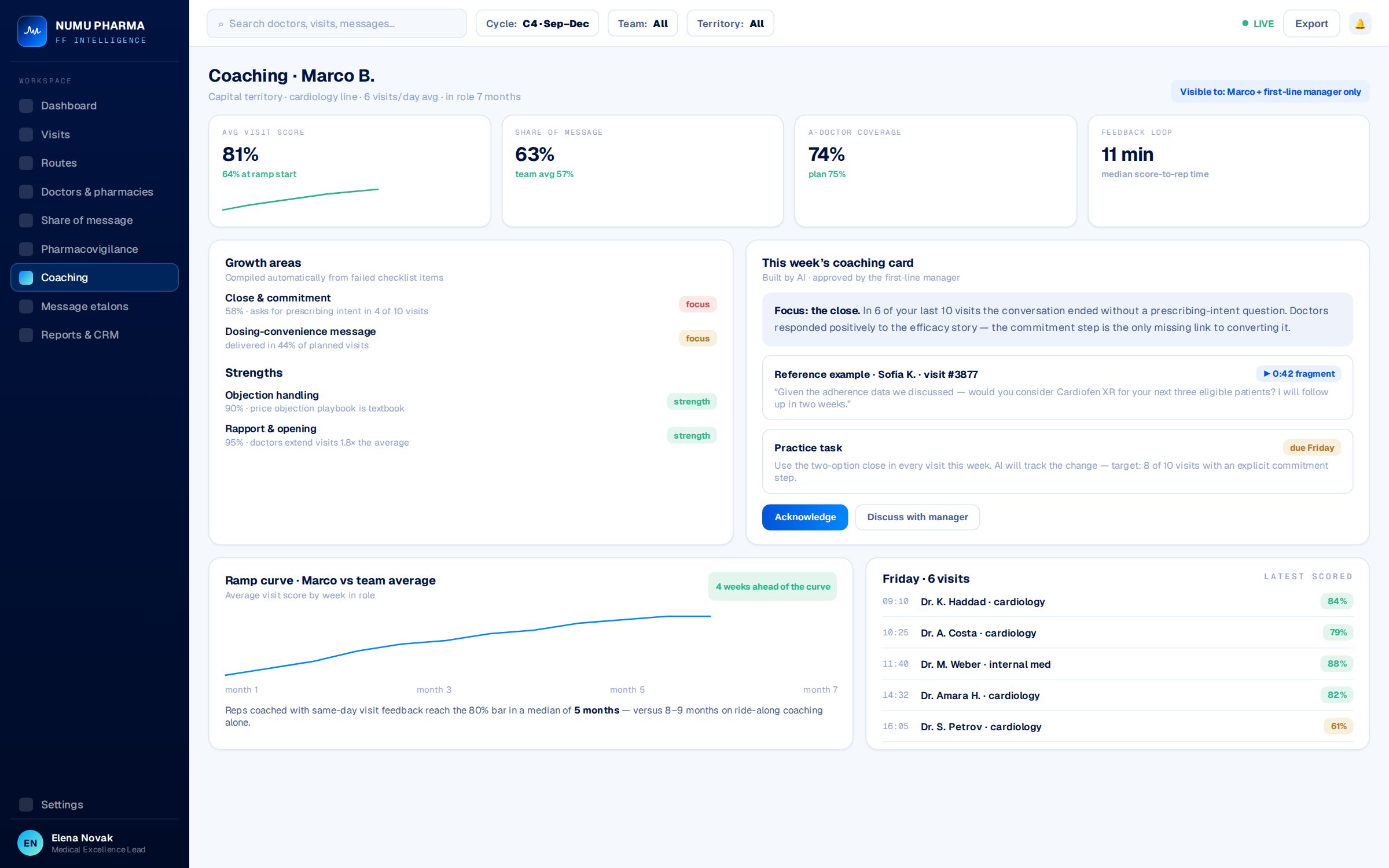
The system does not put marks in anyone’s file. It gives reps something they have never had: an accurate picture of their own visit and a clear route to a bigger bonus.
Scores are visible to the rep and their first-line manager only. Coaching-only mode at launch: the system helps people earn more by getting better, and that is how the field accepts it.
The breakdown arrives as the rep walks out of the office. A mistake gets corrected on the next visit the same day, not next quarter when the cycle is reviewed.
Scoring runs on your checklist, so the standard is identical in every territory and under every manager. Territories become comparable for the first time.
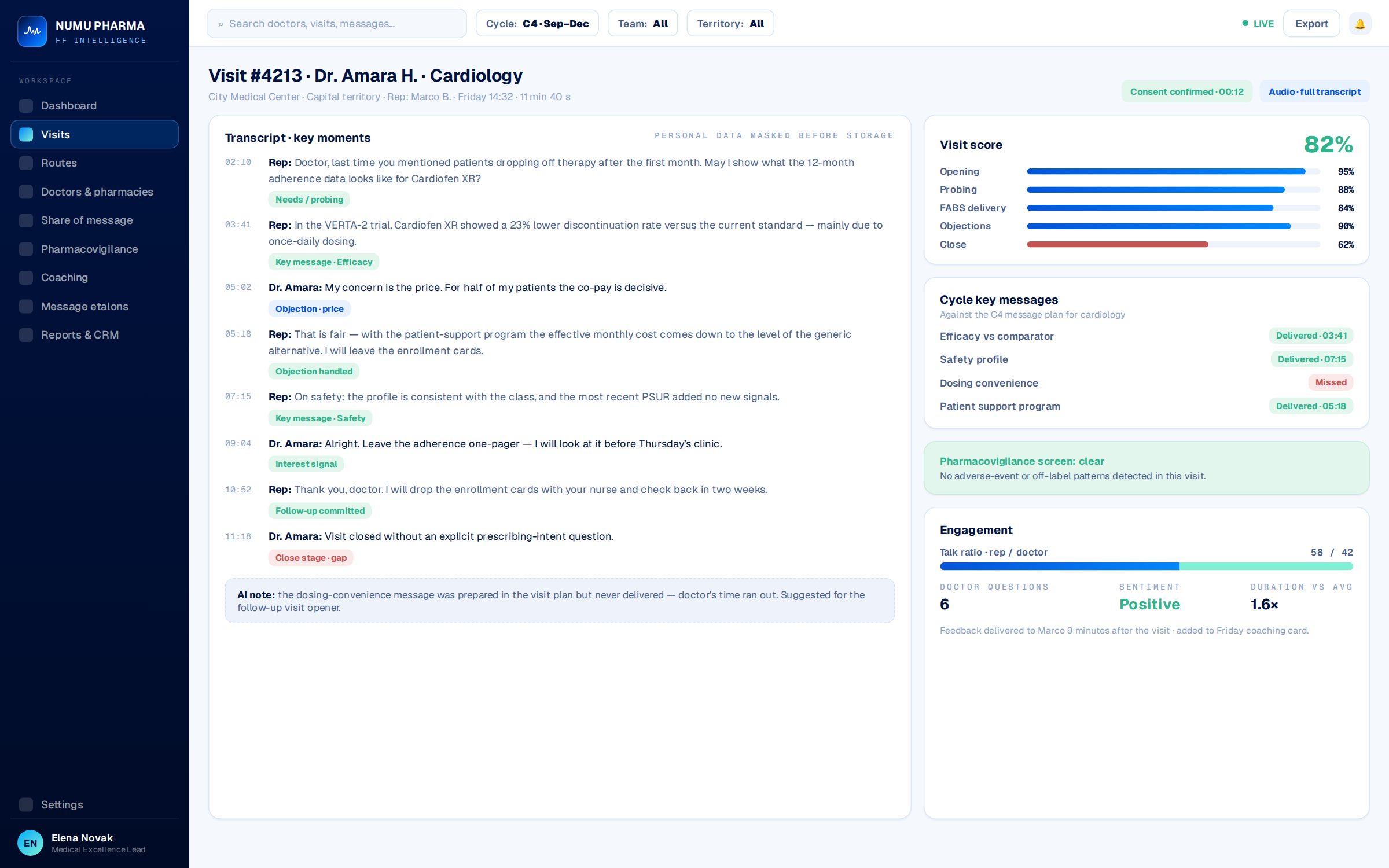
Pre-call, opening, needs discovery, FABS detailing, objection handling, close, post-call — each stage scored 0–2 against your own checklist, exactly as your trainers calibrated it.
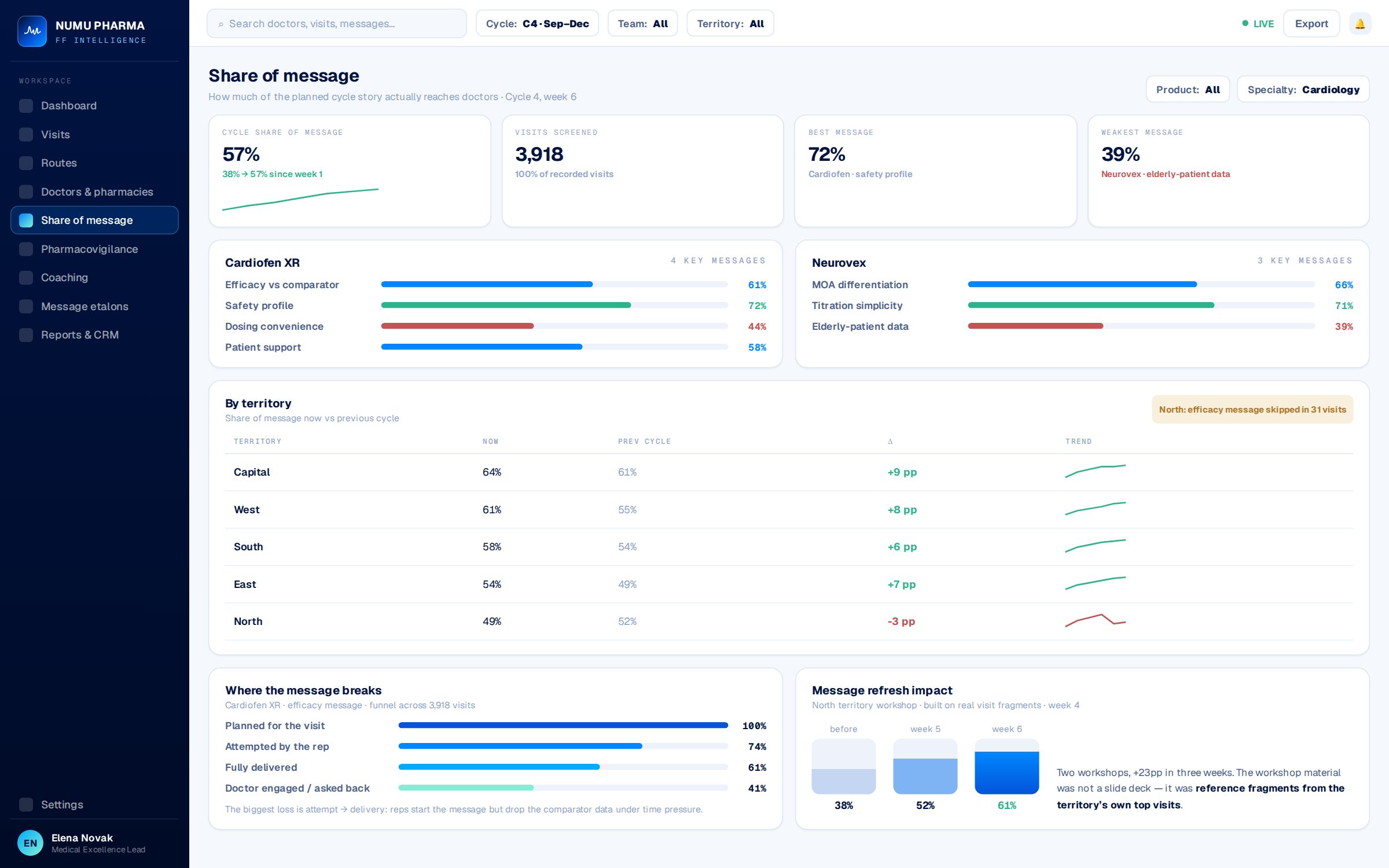
Which key messages of the cycle actually reached the doctor, for which brand and which specialty — measured on real conversations rather than on the rep’s recollection.
Real objections ranked by frequency, with the rebuttals that worked and the ones that did not. Brand teams get the field’s answer to their arguments within a cycle, not after it.
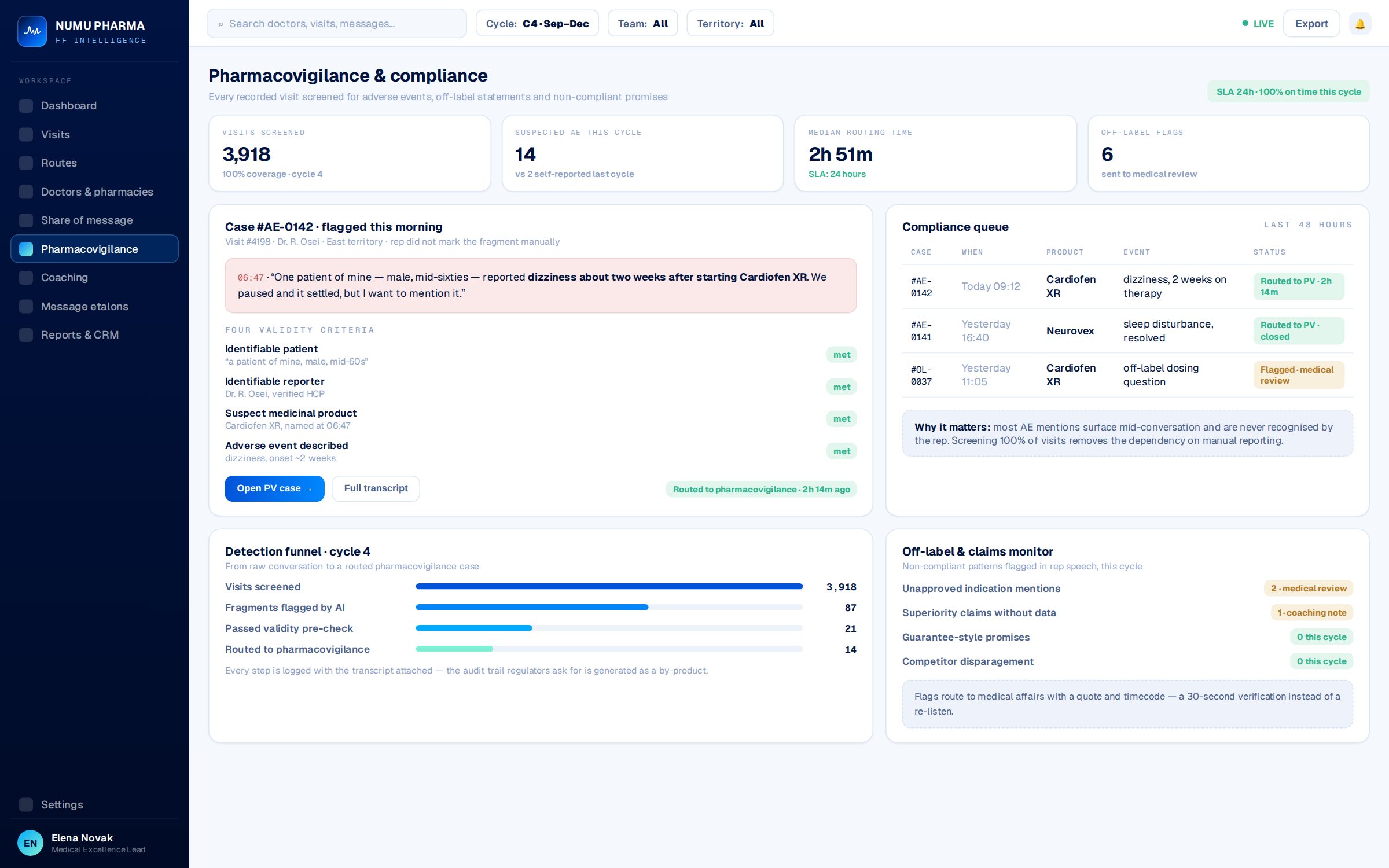
A suspected adverse event is flagged against the four validity criteria and routed the same day, inside the 24-hour SLA. Off-label claims, head-to-head comparisons, incentives and events-for-prescriptions are detected in the same pass.
How much of the visit the doctor actually spoke, and how the time split across the two or three brands carried into the room. A rep who talks for 80% of the visit is not discovering needs, and now that is visible.
A draft report is generated from the actual conversation. The rep confirms it instead of composing it from memory — which returns 30–40 minutes of field time per day and puts honest data into CRM.
The visit is captured through a phone app or a smart badge. Capture of the other party stops if consent is not given. Noise suppression is tuned for consulting rooms and pharmacy floors.
A transcript separated into rep and doctor, with third voices filtered out. Names and patient details are masked before anything is written to the database.
The real dialogue is matched against the corporate standard: visit structure, needs discovery, FABS arguments, cycle messages, objection handling and the close.
Growth zones for the rep, comparable statistics for management and a CRM record built from field reality — without manual micromanagement.
A role-separated transcript with timecodes, the stages of your model marked on it, three growth zones and a reference example of the same objection handled well — by a colleague on the same team, not by a training video.
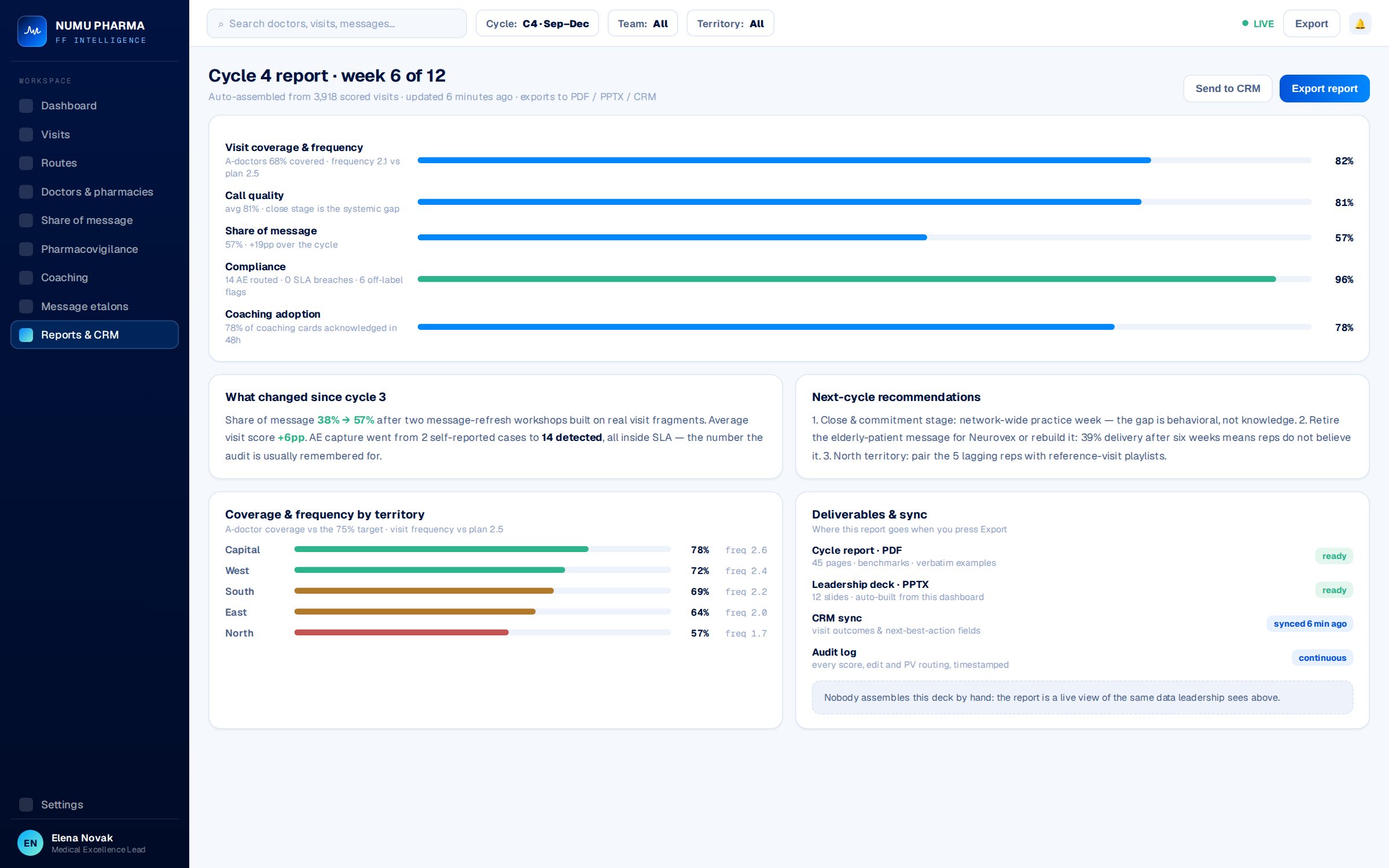
Quality per stage of the model, share of message across the cycle, coverage of the target base and adverse-event alerts — in the morning, not in the quarterly review. Territories are comparable because the standard is one.
Tuned for phone channels and a contact-centre script. No visit model, no cycle, no adverse-event detection.
Scoring on your visit model, brand and INN dictionaries, cycle key messages, adverse-event and off-label alerts.
The manager scores from memory, on about 5% of visits, against criteria that differ from manager to manager. Territories cannot be compared.
100% of visits marked up automatically against one standard. Rep and territory rankings that hold across regions.
One-off visits, auditor subjectivity and the observer effect. Between audits the field is invisible again.
A daily picture built from real visits, with no external auditors and no behaviour change staged for the inspection.
Twelve to eighteen months to a first result, an IT programme on your side and ASR and LLM models you now have to maintain yourself.
A pilot in 30 days, calibration with your own trainers, and model and dictionary updates inside the subscription.
A question worth asking any vendor: will they show share of message across the cycle and an adverse-event alert on live visits during the pilot — or only on the roadmap?
NUMU Group has been shipping since 2014: 11+ years in production, 16 platforms in operation, clients in 50+ countries. Not a startup built around one contract.
3,000+ frontline employees work in the platform every day and 100,000+ points of sale are covered by the platform. Pharma is a configuration of a working core.
100+ specialists across four development centres, from UTC+1 to UTC+9, behind an international group of venture and private investors from seven countries.
The platform deploys inside your own boundary. Audio, transcripts and scores stay with you and do not depend on an external service staying available.
These are not renders — they are live screens from the FF Intelligence workspace. What a medical excellence lead opens every morning instead of waiting for the cycle post-mortem.
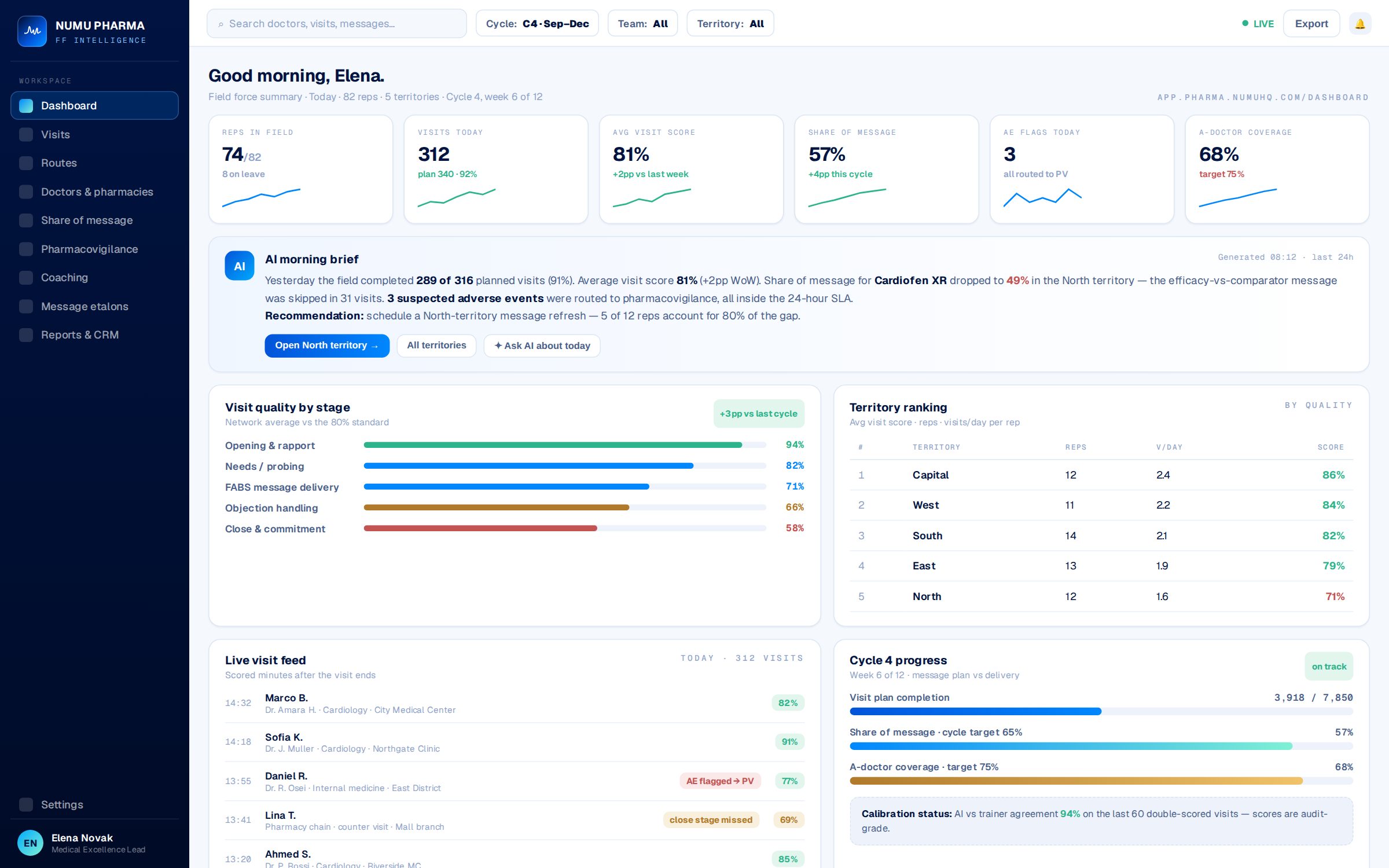
A double visit covers roughly one visit in twenty, is stressful for the rep, and shows untypical behaviour. FF Intelligence reviews 100% of visits against the same checklist, silently and identically in every territory — so scores are comparable and coaching is based on typical behaviour, not a performance for the observer.
Consent is explicit: capture of the other party stops if consent is not given, and that state is logged. Names and patient details are masked before anything is written to the database, so patient data never reaches storage.
That is the core of the product. Your stages, your scale, your FABS structure and your cycle key messages are configured during the pilot, and scoring is calibrated side by side with your own trainers until the AI agrees with them.
The system checks the fragment against the four validity criteria and routes a suspected case to pharmacovigilance the same day, inside a 24-hour SLA, with the transcript attached. Off-label claims and non-compliant promises are flagged in the same pass.
A pilot on one team of 8–10 reps takes 30 days, including dictionary and checklist configuration for your portfolio. It ends with a report on real visit quality, share of message and the compliance picture, plus a scale-up plan.
Yes. The platform deploys on-premise or in a private cloud, with AES-256 encryption, role-based access, an audit log, and a local LLM available on request when nothing may leave your perimeter.
A pilot on 8–10 reps: we configure dictionaries and the checklist for your portfolio, calibrate scoring with your trainers, and show real visit quality, share of message and the compliance picture. It ends with a report and a scale-up plan. How a pilot runs →